SEO Audit Basics That Help Med Spas Get Found


Your website looks polished, your services are top-tier, and your staff is highly credentialed. Yet your phone isn’t ringing from new patients who found you on Google. This is one of the most frustrating situations nurse practitioners and wellness clinic owners face, and the culprit is almost always an invisible layer of technical and content problems that no amount of good design can fix. An SEO audit is the diagnostic tool that surfaces exactly what’s blocking your visibility, giving you a clear roadmap to ranking higher and attracting the patients who are actively searching for what you offer.
Table of Contents
Key Takeaways
Point | Details |
SEO audits uncover obstacles | They identify technical, local, and content issues blocking top search rankings. |
Med spa websites face unique SEO challenges | Challenges like local search, speed, and content quality are especially crucial for healthcare providers. |
Practical audits drive real patient growth | Following a step-by-step audit process leads to more Google visibility and patient bookings. |
Ongoing review matters | Regular audits and improvements are essential for lasting Google results, not just a quick fix. |
What is an SEO audit?
An SEO audit is a structured evaluation of your website’s ability to rank in search engines like Google. Think of it the way you’d think about a comprehensive lab panel for a new patient. Just as labs reveal what’s happening beneath the surface when someone looks completely fine on the outside, an SEO audit reveals what’s happening beneath your website’s surface when it looks beautiful but performs poorly in search results.
For med spas and wellness centers offering services like hormone replacement therapy, peptide protocols, weight loss programs, or hair restoration, ranking on Google isn’t optional. It’s how patients find you before they find your competitors. SEO audits reveal technical and content issues that silently block your Google rankings, issues that a basic website redesign will never touch.
A typical audit examines several interconnected layers of your website:
Technical structure: How search engine bots crawl and index your pages
Content quality: Whether your pages actually answer patient questions with enough depth
On-page optimization: Keyword placement, heading structure, and metadata
Local SEO: How well your practice appears for “near me” searches in your area
Backlink profile: The quantity and quality of other websites linking to yours
A redesign might give your site a fresh look, but it doesn’t fix a broken sitemap, missing schema markup, or 47 pages that Google has blocked from indexing. Those are audit findings, not design decisions.
“A beautiful website that Google can’t read is like a fully stocked clinic with no signage. Patients simply won’t find their way to you.”
Pro Tip: Schedule a full SEO audit at least twice per year, ideally after any major site changes or platform migrations.
Core components of an SEO audit
Once you understand the basic concept, it helps to see what a real audit actually covers. The components aren’t mysterious, but each one carries specific weight in how Google decides to rank your pages over your competitors.
Technical SEO is the foundation. This includes checking your site speed (Google penalizes slow-loading sites), confirming that every page is secured with HTTPS, identifying crawl errors that prevent Google from reading your content, and reviewing your XML sitemap for accuracy. For med spa websites, technical issues are shockingly common. Many practices use outdated WordPress themes or page builders that generate bloated code, dragging down load times on mobile devices.

On-page SEO looks at how well each page is optimized for the specific terms your prospective patients type into Google. This includes whether your heading structure flows logically (H1, H2, H3), whether your service pages target specific keywords like “B12 injections near me” or “testosterone therapy for men in [your city],” and whether your internal linking structure helps Google understand which pages matter most.
Local SEO is critical for any brick-and-mortar wellness practice. Solid healthcare web design is tightly integrated with local signals, including your Google Business Profile accuracy, the consistency of your Name, Address, and Phone number (NAP) across every online directory, and whether you’ve built local citations on platforms like Healthgrades, Zocdoc, and Yelp.
User experience rounds out the audit. Google’s algorithm increasingly rewards websites where visitors actually stay, click, and convert. If patients land on your site and immediately leave because it’s hard to navigate on a phone, that bounce signal works against your rankings.
Audit Component | What It Checks | Impact on Med Spa Visibility |
Technical SEO | Site speed, crawlability, HTTPS, sitemap | High: Blocks indexing if broken |
On-page SEO | Keywords, headings, meta tags, content | High: Determines what terms you rank for |
Local SEO | Google Business Profile, NAP, citations | Very High: Drives local patient traffic |
Content quality | Depth, accuracy, patient intent | High: Builds authority and trust |
User experience | Navigation, mobile design, load speed | Medium-High: Reduces bounce rate |
Backlink profile | Quality and quantity of inbound links | Medium: Supports domain authority |
Understanding these common SEO problems in healthcare before you start your audit helps you know what you’re actually looking for when you review the results.
Common SEO issues in med spa and wellness websites
Med spa and wellness websites tend to fail in predictable ways. Knowing the most frequent issues found during audits means you can start prioritizing before you even run your first tool.
Thin or duplicate content is the most common problem. Many med spa websites have service pages that are only two or three sentences long. Google reads those pages, decides they don’t sufficiently answer patient questions, and ranks a competitor’s more thorough page instead. Duplicate content, like copying the same paragraph about “hormone therapy benefits” across five different pages, confuses search engines and dilutes your rankings.
Missing or inconsistent local data is the second major issue. If your address appears slightly differently on Google versus Yelp versus Healthgrades, Google loses confidence in the accuracy of your data and ranks you lower in local results. Missing location pages for practices that serve multiple cities or neighborhoods are another frequent gap. Med spa SEO strategies consistently highlight that many med spa sites lack effective local keywords alongside robust technical foundations, which is a double penalty.
Slow websites and broken mobile layouts push patients away before they even read your services. More than 60% of healthcare searches now happen on mobile devices, so a site that looks fine on a desktop but renders poorly on a phone is actively losing you patients daily.
Weak or absent Google reviews and an incomplete Google Business Profile hurt local rankings directly. Google rewards practices that look credible and active online, and a profile with no photos, outdated hours, and zero recent reviews signals neglect. You can learn more about integrative health SEO to see how practices in functional and wellness medicine handle this strategically.
Applying quality standards in healthcare marketing to your SEO strategy means your content needs to be both accurate and optimized. Cutting corners on either front damages your authority with both Google and your prospective patients.
Typical audit findings and priority levels:
Crawl errors and blocked pages (Fix immediately: these prevent Google from seeing your site)
Missing or wrong NAP data on local directories (Fix within one week: directly affects local rankings)
Thin service pages under 500 words (Fix within one month: major content opportunity)
Slow page load times over 3 seconds (Fix within one month: penalizes mobile rankings)
Missing or incomplete Google Business Profile (Fix immediately: free and high-impact)
No recent Google reviews or review response strategy (Ongoing: reputation signals matter)
Pro Tip: Start your audit fixes with the issues that directly block Google from reading your site. Even the most brilliant content is worthless if Google can’t index the page it lives on.
How to perform an SEO audit: A step-by-step workflow
Running your first audit might feel overwhelming, but breaking it into five focused steps makes it approachable even if you’re not a tech-savvy marketer.
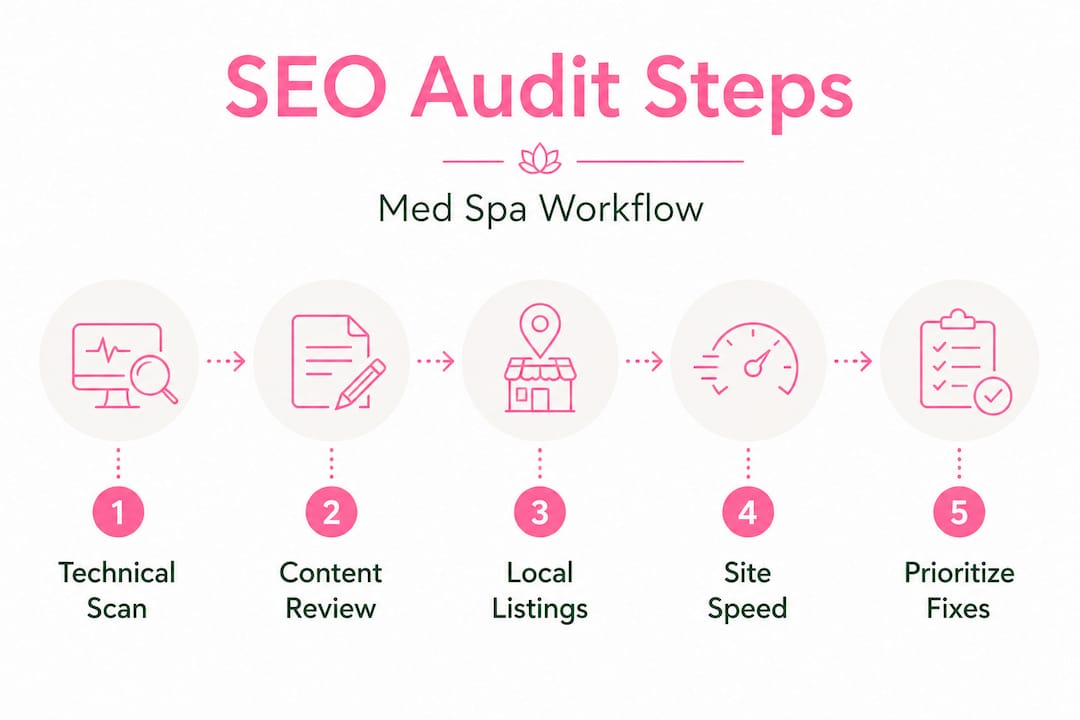
Step 1: Run a technical scan. Use a tool like Google Search Console (free) to check for crawl errors, indexing issues, and mobile usability warnings. Look specifically at pages marked “not indexed” and understand why. Also run a page speed test using Google PageSpeed Insights to see your load time scores for mobile and desktop.
Step 2: Review your content for medical relevance, accuracy, and keyword alignment. Go through every service page you offer, whether that’s semaglutide weight loss, TRT, IV therapy, or PRP hair restoration, and ask honestly: does this page answer the questions a real patient would ask? Does it include the specific terms they’d search? Does it clearly explain what to expect, who is a candidate, and how to book? If the answers are no, that page needs a rewrite.
Step 3: Check your local SEO listings and Google Business Profile. Search your practice name on Google and review the profile that appears. Is it fully filled in? Are your photos recent and professional? Do your hours reflect current scheduling? Then check your NAP consistency across major directories. SEO strategies for healthcare providers consistently show that NAP consistency is one of the fastest wins available in local search.
Step 4: Audit your site speed, mobile design, and user experience. Pull up your website on your own phone. Navigate to three different service pages. Try to find your contact number and book an appointment. If any part of that experience is frustrating or confusing, your patients feel the same way. Use Google PageSpeed Insights to identify specific elements slowing your mobile load time.
Step 5: Prioritize your fixes and build a re-test schedule. After completing steps one through four, sort your findings by impact level. Fix the highest-impact technical issues first, then move to content, then local, then user experience improvements. Revisit your wellness center SEO tips after implementing each round of changes to measure progress.
Regular audits help clinics maintain high search visibility rather than seeing it spike and fade. A single audit is a great start, but ongoing monitoring is what separates consistently visible practices from those that disappear from search results after six months.
Pro Tip: Keep a simple spreadsheet to track every audit finding, the fix applied, and the date completed. This becomes your practice’s SEO health record and makes future audits dramatically faster.
Why most healthcare SEO audits fail—And how to actually win with Google
Here’s what most SEO articles won’t tell you: running an audit isn’t hard. Acting on it correctly is. The reason most healthcare and med spa SEO audits produce zero lasting results isn’t poor tools or insufficient data. It’s misplaced priorities.
Clinics consistently focus on cosmetic SEO issues, fixing a meta description here, adding a keyword to a page title there, while ignoring the structural problems that actually move rankings. They treat real-world healthcare SEO audits like a one-time project with a finish line rather than a continuous quality assurance process.
The most effective approach we’ve seen is to align your SEO strategy entirely around patient intent. Not what you want to rank for. What your patients are actually typing into Google at 11pm when they’re deciding whether they need a consultation. Those two things are often very different. A nurse practitioner might want to rank for “bioidentical hormone therapy for women,” but the patient is searching “why am I tired all the time despite sleeping enough.” Building content around patient questions, then connecting those questions to your services, is what separates high-performing practices from everyone else.
Another uncomfortable truth: small technical wins compound. Fixing a single crawl error won’t change your life. But fixing crawl errors, improving your mobile load speed, updating your Google Business Profile, and adding location-specific service pages all in the same quarter absolutely can shift your ranking trajectory in a meaningful way.
Treat your audit findings the way you treat a patient’s lab results. Not every abnormal value requires immediate intervention, but ignoring the pattern over time leads to serious problems. Ongoing monitoring is the key to sustained visibility, not a single dramatic fix.
Maximize your practice’s visibility with proven SEO support
Running a successful med spa or wellness clinic means your time is already spoken for. Performing thorough, ongoing SEO audits on top of patient care, staff management, and compliance demands is a lot to take on alone.
That’s where a specialized team makes a real difference. Our medical spa SEO & marketing services are designed specifically for practices like yours, covering everything from full technical audits to local SEO optimization and content strategy. We work exclusively with med spas, wellness clinics, and healthcare providers, so we understand the compliance landscape, the patient acquisition funnel, and the specific keywords that bring consultations, not just clicks. Our wellness center marketing experts pair audit findings with execution so nothing sits in a spreadsheet collecting dust. If you’re ready for your practice to rank where your patients are searching, our med spa SEO specialists are ready to help.
Frequently asked questions
How long does an SEO audit take for a typical med spa website?
Most basic audits take a few hours using free tools, but a thorough review covering technical, local SEO, and content analysis may take several days to complete fully. The larger your site and service menu, the more time a complete audit requires.
Do I need any special tools to run my own SEO audit?
Free tools like Google Search Console and PageSpeed Insights give you a strong starting point, but professional software or a specialist team will uncover deeper issues that free tools miss. Technical SEO factors like crawl depth and structured data errors are hard to catch without dedicated audit platforms.
What are the signs I need a professional SEO audit?
If your site traffic has been flat for several months, you’re not appearing in local search results for your core services, or your new patient inquiries have dropped off unexpectedly, a full audit is the right next step. Most med spa sites have more fixable problems than their owners realize.
How often should I repeat an SEO audit for lasting results?
Every six to twelve months is the recommended cadence for most med spa and wellness clinic websites. Regular audits help you stay ahead of Google algorithm changes and catch new issues before they significantly impact your traffic.
Will an SEO audit fix my website’s ranking problems on its own?
No. An audit is a diagnostic tool, not a treatment. It tells you exactly what’s wrong and what to prioritize, but you or your team must implement the recommendations for rankings to improve. As any good SEO approach will confirm, ongoing monitoring and action are what produce lasting results.
Recommended
SEO for Med Spas | Get Found on Google | Citrus Ridge Marketing
Medical Spa Marketing Agency | SEO & Patient Acquisition Services
Web Design for Med Spas & Medical Spa Website Design | Citrus Ridge Marketing
SEO for Wellness Centers | Peptides, HRT, IV Hydration & More | Citrus Ridge Marketing
SEO site web : maîtrisez les clés pour booster votre visibilité
Comments