How to set up Google Ads for med spas: step-by-step


Running Google Ads for a med spa or wellness center sounds straightforward until you hit your first disapproval, burn through budget on unqualified clicks, or realize your landing page violates healthcare ad policies. Many practices spend thousands before figuring out what actually works. This guide walks you through every stage of setup, from account creation and billing to building compliant campaigns and tracking real results, so you can attract new clients without the costly trial and error that trips up most providers.
Table of Contents
Key Takeaways
Point | Details |
Compliance is critical | Healthcare Google Ads must follow strict ad policies and avoid guarantee or prescription-only language. |
Start with high-intent keywords | Target services potential clients are actively searching for to boost campaign ROI. |
Track and optimize results | Monitor conversions and use data to continually improve campaign performance. |
Certification may be required | Certain medical ads, especially injectables, need Google certification for approval. |
What you need before creating Google Ads for your med spa
Before you create your first campaign, make sure you have all foundational elements in place so your efforts aren’t rejected or wasted out of the gate.
Getting your prerequisites right saves you from the most common early frustrations. Here’s what you need to gather before opening Google Ads:
A Google account tied to your business email, not a personal Gmail
Your verified business website with a working URL, clear service descriptions, and contact information
A payment method ready (credit card, debit card, or bank account depending on your country)
Your legal business name exactly as it appears on your business registration
A compliant landing page that matches what your ads will promise
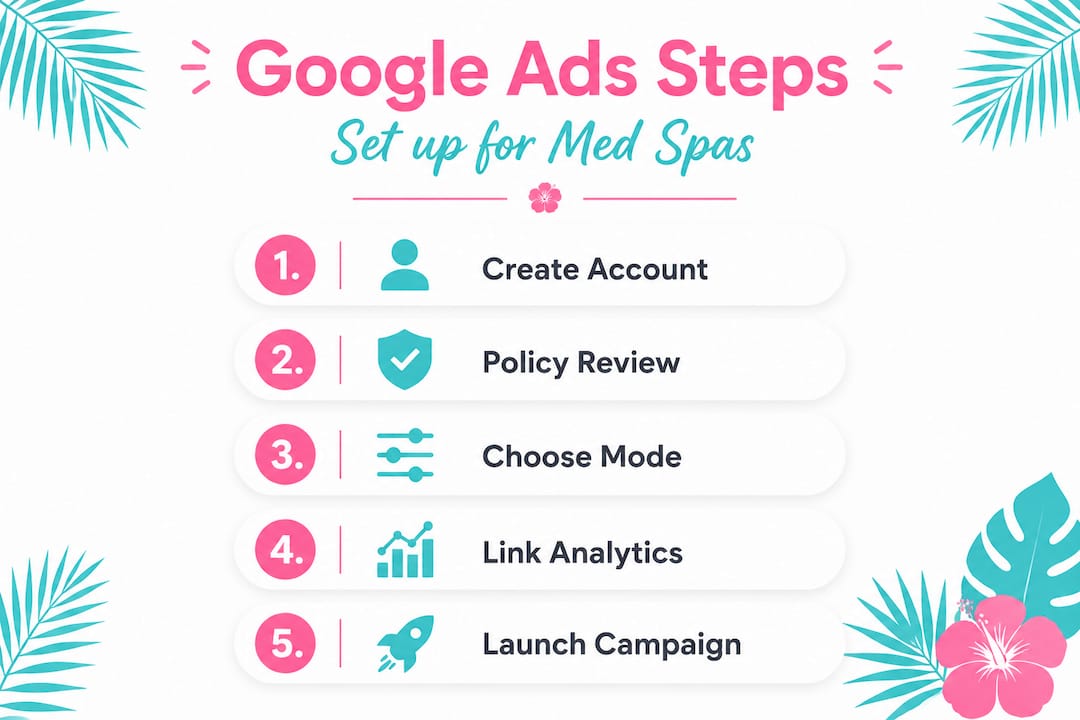
The account creation process requires you to sign up at ads.google.com, enter your business name and website, confirm billing country, time zone, and currency, then set up a payments profile as either an individual or organization, add your payment method, and finalize to access the dashboard.
Healthcare ad policies are non-negotiable. Google’s healthcare advertising rules prohibit guarantees or results claims, restrict prescription-only terminology without certification, and require that landing pages accurately reflect the services advertised. Non-invasive services like facials and IV therapy are generally permitted with factual language, while injectables require more careful handling.
Pro Tip: Before spending a single dollar on ads, run your landing page through Google’s Ad Preview tool to check how it renders and whether the messaging matches your intended ad copy. A mismatched landing page is one of the top reasons med spa ads get flagged. You can also review healthcare website readiness benchmarks to make sure your site structure supports ad compliance from day one.
Requirement | Why it matters | Common mistake |
Business email Google account | Required for account ownership | Using a personal Gmail |
Verified website | Google checks landing page compliance | Outdated or broken site |
Payments profile | Billing setup before campaigns launch | Skipping organization profile |
Compliant ad copy | Avoids disapprovals and suspensions | Making results claims |
HIPAA-adjacent consent tracking | Best practice for patient privacy | No consent mechanism on forms |
Step-by-step guide: Setting up your Google Ads account
With those prerequisites checked off, you’re ready to open your Google Ads account and set the stage for your first campaign.
The full account setup follows a clear sequence. Here’s how to move through it without getting stuck:
Go to ads.google.com and click “Start now.” Sign in with your business Google account.
Enter your business name and website URL. Use your exact legal name and the specific landing page URL where clients will book or inquire.
Select your billing country, time zone, and currency. These settings cannot be changed after setup, so double-check them carefully.
Choose your payments profile type. Select “Organization” if you’re billing under a business entity. “Individual” is only appropriate for sole proprietors without a registered business name.
Add your payment method. Google accepts major credit cards and debit cards. Some accounts qualify for monthly invoicing after a track record is established.
Finalize and access your dashboard. You’ll land in the Google Ads interface where you can begin building campaigns.
One detail many providers overlook: Google will attempt to push you toward creating a “Smart Campaign” immediately after signup. Skip this. Smart Campaigns offer very limited control over targeting and bidding, which matters a lot in a regulated healthcare environment. Click “Switch to Expert Mode” to access the full campaign builder.

Pro Tip: Set up a Google Analytics 4 (GA4) property and link it to your Google Ads account before launching any campaigns. This connection lets you import conversion events directly and gives you a much richer picture of how visitors behave after clicking your ad.
Account setting | Recommended choice | Reason |
Campaign mode | Expert Mode | Full targeting and bidding control |
Payments profile | Organization | Proper business billing |
Time zone | Your local time zone | Accurate scheduling |
Currency | USD | Avoid conversion complications |
Conversion tracking | GA4 linked | Richer attribution data |
For wellness providers who also want organic visibility alongside paid ads, building a strong foundation through a wellness SEO strategy compounds the return on your ad spend by capturing clients who prefer organic results.
Build your first compliant campaign: Goals, targeting, and assets
Now that your account is active, it’s time to build the campaign that connects you with new clients without running afoul of healthcare advertising policies.
The structure of your first campaign determines everything downstream. Follow these steps to build it correctly:
Select your campaign goal. For most med spas, “Leads” is the right choice. It optimizes for form submissions, phone calls, and consultation bookings.
Choose your campaign type. Search campaigns work best for high-intent service queries. Performance Max can work for broader awareness but requires careful asset management and close monitoring in healthcare contexts.
Build your ad assets. You need at least 3 headlines (30 characters each), 2 descriptions (90 characters each), and a final URL. Keep language factual and service-focused.
Set your keyword targeting. Focus on high-intent local keywords like “IV therapy near me,” “facial rejuvenation Tampa,” or “hormone therapy clinic Dallas.”
Set your daily budget and bidding strategy. Start with “Maximize Conversions” once you have conversion tracking live, or use “Manual CPC” while you gather initial data.
Review and launch. Before submitting, verify every headline and description against Google’s healthcare policies.
What makes compliant ad copy for med spas?
Describe services factually: “Botox injections administered by licensed providers” rather than “Look 10 years younger guaranteed”
Avoid superlatives like “best,” “fastest,” or “most effective” without substantiation
Skip before-and-after language entirely in ad text
Use location-specific language to improve relevance and Quality Score
“Avoid prescription terms without certification; non-invasive services are generally ok with factual language; injectables require factual copy and may require Google certification; landing pages must comply with ad content.” Google Ads healthcare policy
For services like weight loss programs or hormone replacement therapy, pairing your paid ads with strong organic content through med spa SEO creates a two-channel presence that builds trust and captures clients at multiple stages of their decision.
Pro Tip: Create separate ad groups for each service category, such as one for injectables, one for body contouring, and one for IV therapy. This lets you write tightly relevant ad copy for each group and track performance by service line, which is critical for budget decisions. Providers who also want to understand broader digital visibility can explore healthcare SEO insights to see how organic and paid strategies complement each other.
Avoiding costly mistakes: Compliance, certification, and approval tips
Even with the right setup, many campaigns for med spas and wellness providers stall due to non-obvious compliance issues.
The most common disapproval triggers include:
Results or guarantee language in headlines or descriptions (“Lose 20 pounds in 30 days”)
Before-and-after references anywhere in ad text or on the linked landing page
Uncertified use of prescription drug brand names like Ozempic or Semaglutide in ad copy
Landing pages that don’t match ad claims or that lack clear service descriptions
Missing business contact information on landing pages for healthcare services
Google requires certification for certain restricted healthcare categories. If your med spa offers injectables, weight loss medications, or other regulated treatments, you may need to complete Google’s certification process before those ads can run. The healthcare ad policy page outlines which categories require certification and how to apply.
“Injectables require factual language and may require Google certification; avoid brand names if uncertified; no before-and-after guarantees; landing pages must comply with all ad content claims.” Google Ads healthcare policy
When an ad gets disapproved, Google sends a notification with a policy reason. Don’t just edit and resubmit blindly. Read the specific policy cited, audit your landing page for the same issue, and fix both the ad and the page before resubmitting. Repeated disapprovals can flag your account for manual review, which slows everything down.
HIPAA compliance is not directly enforced by Google, but implementing consent tracking on your forms and being thoughtful about how you handle patient inquiry data is smart practice. Many providers overlook this until a problem arises. Understanding why healthcare ads get disapproved across platforms gives you a useful cross-channel perspective since many of the same content rules apply on Google.
Pro Tip: Build a simple internal checklist for every new ad you write. Run through it before submitting: no guarantees, no prescription brand names without certification, factual service language only, landing page matches ad claims, contact info visible. Five minutes of review prevents days of disapproval delays.
Measuring success: What metrics to track and how to optimize
Once your campaigns are live and approved, consistently tracking performance helps you turn data into booked clients.
The core metrics every med spa should monitor:
Impressions: How many times your ad appeared in search results
Clicks: How many people clicked through to your landing page
Click-through rate (CTR): Clicks divided by impressions; a healthy rate for healthcare search ads is typically 3 to 6 percent
Conversion rate: The percentage of clicks that result in a booked consultation or form submission
Cost per conversion: Total ad spend divided by number of conversions; this is your real ROI metric
Setting up conversion tracking is essential before you can optimize meaningfully. In Google Ads, navigate to Tools > Conversions and create conversion actions for form submissions, phone calls, and appointment bookings. Link these to your GA4 property for cross-channel visibility.
Metric | What it tells you | Optimization action |
Low CTR | Ad copy isn’t resonating | Test new headlines |
High CTR, low conversions | Landing page isn’t converting | Revise page offer or layout |
High cost per conversion | Keywords too broad or competitive | Tighten keyword match types |
Low impressions | Budget too low or bids too conservative | Increase budget or bids |
High bounce rate | Traffic mismatch with landing page | Align ad and page messaging |
Simple optimization steps that move the needle:
Pause keywords with zero conversions after 30 or more clicks
Test two to three headline variations per ad group and let data determine the winner
Add negative keywords to filter out irrelevant searches (for example, “free,” “DIY,” “school”)
Review search term reports weekly to find new keyword opportunities and irrelevant traffic
Connecting your Google Ads data to your broader medical spa marketing strategy lets you see which channels contribute to bookings and where to reinvest for growth.
What most med spas get wrong with Google Ads (and how you can win)
Here’s an uncomfortable truth: most med spas running Google Ads are essentially paying to educate their competitors’ future clients. They target broad keywords, write generic ad copy, and send traffic to a homepage that wasn’t built to convert. Then they conclude Google Ads doesn’t work for their practice.
The real problem isn’t the platform. It’s the approach.
The “set it and forget it” mindset is the single biggest budget drain in this industry. Google’s algorithm rewards engagement signals, and a campaign that isn’t actively managed will drift toward cheaper, less relevant clicks over time. Weekly reviews aren’t optional; they’re the job.
The second mistake is underestimating the power of offer differentiation in ad copy. When every med spa in your market is running ads that say “Book a free consultation,” the ones that win are the ones that say something specific and credible. “Same-week appointments available” or “Licensed NP on staff for all injectable services” tells a prospective client something real about what makes your practice different.
Here’s the counterintuitive part: your compliance expertise is itself a marketing asset. Practices that follow healthcare ad standards and communicate safety and credibility in their copy build more trust with high-value clients than those chasing clicks with bold claims. Clients considering hormone therapy or injectables are making a health decision, not just a purchase. They respond to professionalism.
For providers in high-competition metros, generic keywords like “med spa” or “Botox” are expensive and often unprofitable. The better play is layering in service-plus-location combinations, targeting by radius around your clinic, and using ad scheduling to concentrate spend during hours when your staff can actually answer calls. Understanding marketing in the medical niche means recognizing that precision beats volume every time in this space.
Level up your Google Ads strategy with expert support
Managing compliant, high-performing Google Ads campaigns for a med spa or wellness center is genuinely complex work. Between policy updates, keyword research, conversion tracking, and ongoing optimization, it’s a significant time investment on top of running a clinical practice.
Smart practitioners partner with specialists who understand both the marketing mechanics and the regulatory landscape specific to healthcare advertising. At Citrus Ridge Marketing, we build and manage Google Ads campaigns for med spas that are structured for compliance from day one and optimized for real bookings, not just clicks. Whether you need a full-service wellness center marketing strategy or a polished, conversion-ready med spa website to support your campaigns, we can help you grow faster and spend smarter.
Frequently asked questions
Do I need medical certification to run Google Ads for injectables or weight loss services?
This is a bit tricky. If you are explicitly advertising injectables or weight loss medications, then yes. However, if you use consultative language, you are more likely to get approved.
Can I use before-and-after photos or guarantee results in my ads?
No, Google prohibits result guarantees and before-and-after claims in healthcare-related ads due to strict policy restrictions that apply to all wellness and medical service providers.
What kinds of keywords should my med spa focus on for Google Ads?
Focus on high-intent, local keywords such as “Botox near me,” “dermal fillers Tampa,” or “IV therapy LA,” as these high-intent search terms attract clients who are ready to book rather than just browsing.
Is HIPAA compliance required to run Google Ads for my wellness center?
Google Ads does not directly require HIPAA compliance, but implementing consent tracking best practices for patient privacy is strongly recommended to protect your practice and build client trust.
Recommended
Comments